

Cacao is one of the most fascinating and globally important agricultural crops, not only due to its economic impact but also because it is the raw material for one of the most beloved products in the world: chocolate. Beyond its botanical nature, cacao crop represents a profound social narrative. Frequently grown in regions of high vulnerability, the crop often serves as a lifeline for smallholder farmers. Historically, the standardisation of industrial processes has led to a market where the immense effort and investment made by these producers are often undervalued. However, a powerful global movement is gaining momentum, advocating for transparency and fairness through models like Direct Trade, which seek to recognise the true value of the producer’s work.
For the British market—one of the world’s most sophisticated and discerning consumers of high-quality chocolate—this connection between origin and ethics is paramount. In fact, the United Kingdom consistently ranks as one of the largest consumers of ethical and fair-trade chocolate per capita, reflecting a growing demand for transparency that goes from the bean to the bar.
Through these publications, we aim to offer you a comprehensive insight into the universe of cacao: from its fascinating botanical origins to the complex social and economic fabric that sustains it. We want to foster conscious consumption, where knowledge becomes our best ally in valuing every harvest. We invite you to join us on this journey in our new section: Beyond the Bar.
Taxonomic Classification and Origin
The scientific name for cacao is Theobroma cacao L., a designation given by the Swedish naturalist and botanist Carl Von Linneo in the 18th century. Taxonomically, this species belongs to the Malvales order and is part of the Malvaceae family. The meaning of its name comes from Greek and translates literally as “food of the gods”.
Regarding its origin, the most widely accepted theory indicates that the species developed spontaneously in the upper Amazon basin, in a geographical triangle formed by Colombia, Ecuador, and Brazil. From there, its dispersion towards Central America occurred thanks to birds, animals, and nomadic indigenous communities, where cultures such as the Toltecs, Mayas, and Aztecs integrated it into their rituals and economy. Historical records also point to the northwestern region of Venezuela, specifically south of Lake Maracaibo, as a key location in the discovery of wild plants and the pre-Columbian exploitation of the cacao crop.
Tree Characteristics and Morphology
The cacao tree is a woody, perennial species of low stature. In its wild state, it can reach up to 12 metres in height, but in commercial plantations, it is controlled through pruning to maintain a manageable height of between 2 and 4 metres.
IA generated image
- Roots: It has a main taproot (pivot root) that can penetrate up to 1.5 to 2 metres deep to provide good anchorage for the tree. Additionally, it possesses superficial secondary roots in the top 30 centimetres of the soil, which are responsible for absorbing water and nutrients.
- Trunk and branches: The trunk grows vertically to a height of 0.8 to 1.5 metres before branching out to form a structure known as a whorl or “molinillo”.
- Leaves: They are medium-sized, elongated in shape, and attached to the branches via the petiole.
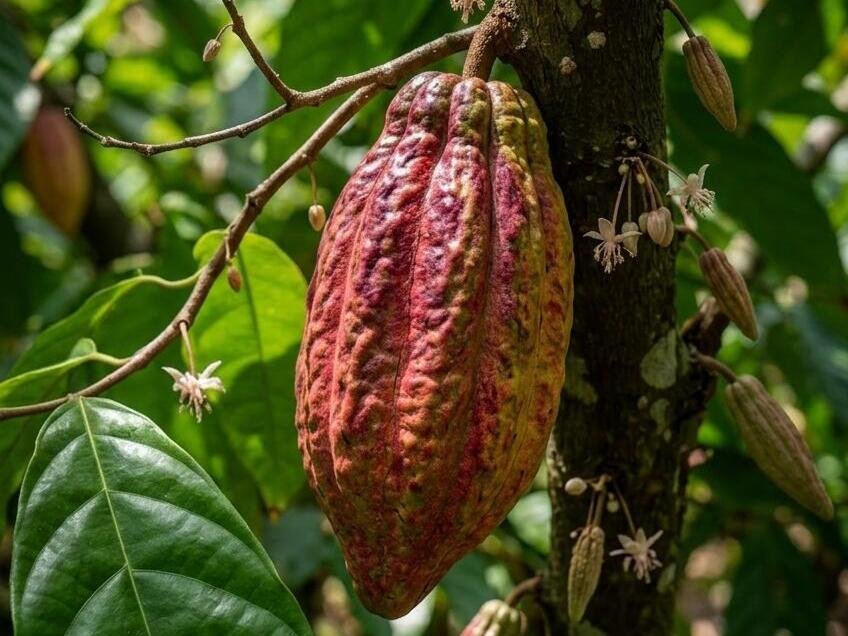
- Flowers: They are hermaphroditic and characterised by being cauliflorous, meaning they sprout directly in clusters on the trunk and woody branches, in sites called floral cushions. They consist of five true white stamens and five false purple ones. Cross-pollination depends primarily on a small insect of the Forcipomyia genus.
- Fruits (Pods): The fruit is a large, fleshy berry weighing between 300 and 1000 grams, protected by a thick shell or pericarp. It has 5 to 10 longitudinal grooves and its colour changes dramatically as it ripens, shifting from green tones to yellow, or from red to orange. Here you can find more information about the cacao fruits shape
- Seeds: Each pod houses between 20 and 50 seeds arranged in rows around a central placenta. These seeds have two cotyledons rich in starch, proteins, and fats, and are covered by a sweet, white pulp known as mucilage.
Global Producing Zones
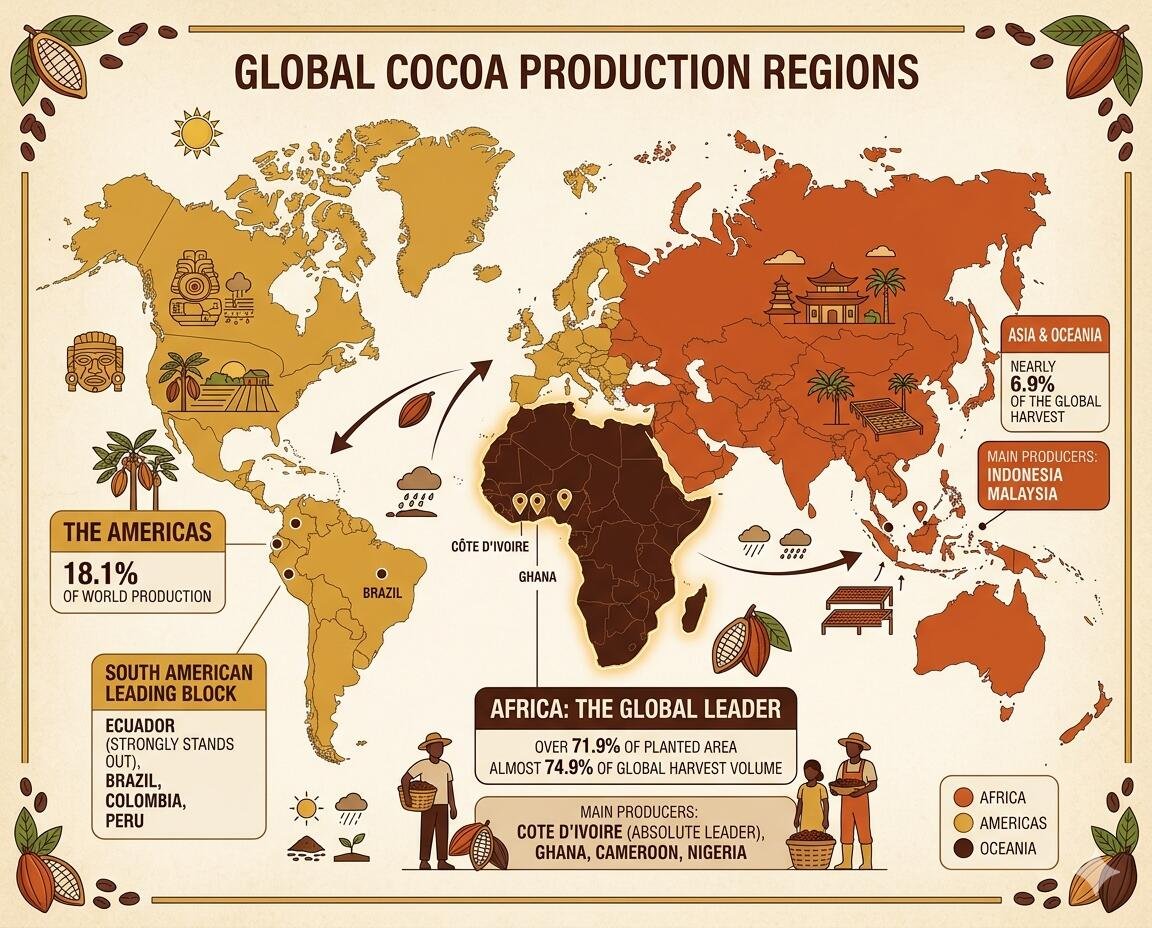
Cacao is a geographically strict crop: it only grows in the tropical belt of the planet, extending from the equator up to 15° or 20° latitude north and south. Global production is divided into three main continental blocks:
- Africa: It is the undisputed giant of cacao, concentrating over 71.9% of the planted area and almost 74.9% of the harvest volume globally. Ivory Coast (Côte d’Ivoire) is the absolute leader, followed by Ghana, Cameroon, and Nigeria.
- The Americas: Represents approximately 18.1% of world production. South American countries lead this block, with Ecuador standing out strongly alongside Brazil, Colombia, and Peru.
- Asia and Oceania: Contribute nearly 6.9% of the global harvest, with Indonesia and Malaysia as the main producers and industrial processors in the region.
IA generated image
Environmental Characteristics (Agroclimatic Requirements)
The cacao tree is highly sensitive to climate changes and requires a very specific environment to express its maximum productive yield. It is an umbrophilic plant, meaning it demands significant percentages of shade, especially during its first years of life.
| Environmental Parameter | Optimal Cultivation Conditions |
| Altitude | Its optimal developmental range is between 500 and 800 metres above sea level (masl), although it is cultivated from sea level up to 1200 masl. |
| Temperature | Average temperatures should range between 22°C and 28°C. It can tolerate annual maximums of 32°C and minimums of 18°C. |
| Precipitation | Requires an abundance of well-distributed water, with ideal levels ranging from 1800 mm to 2600 mm annually. |
| Relative Humidity | It develops best in a constant relative humidity range situated between 70% and 80%. |
| Luminosity / Shade | During its first 4 years, it needs between 50% and 70% shade. In its adult and productive stage, it requires more solar radiation, lowering the shade requirement to 30% – 40%. |
| Winds | It is susceptible to mechanical stress. Continuous winds exceeding 4 metres per second damage the foliage, cause flower drop, and prevent pollination. |
The Cacao Journey Has Only Just Begun
As we have seen, cacao cultivation is a fascinating web where ancient history, botanical complexity, and the demands of a very specific tropical climate intersect. Understanding these generalities is the essential first step to appreciating the enormous agricultural effort that lies behind every bar of chocolate we enjoy.
Help us spread the culture of cacao crop! If you found this journey through the origin and botany of the plant interesting, we invite you to share this article on your social networks or with other enthusiasts of agriculture and chocolate. Let’s ensure that knowledge about the “food of the gods” reaches more people!
Coming up next… The universe of this plant is vast, and this is just the beginning. Stay tuned, because in our next article, we will delve into the Traditional Typologies of Cacao. We will discover the fundamental differences between the most emblematic varieties in the world—such as the delicate Criollo, the hardy Forastero, and the balanced Trinitario—their particular characteristics, and how each one defines the flavour profiles of fine aroma chocolate.
Which is your favourite variety, or which one sparks your curiosity the most? Leave us your comments, and we look forward to seeing you in the next article!
